
If your dog dies at home, first confirm there is no breathing and no heartbeat. Then note the time, put on gloves, and gently place the body on a towel or blanket. Wrap the body, keep it cool, and call your vet or a pet cremation service. You have a few hours to decide what comes next, so you do not have to rush. Your two main options are cremation or burial, and your vet can arrange either.
That is the short version. If you are reading this in the middle of it, take a breath. Nothing here is an emergency anymore. You have time to do this properly, and you have time to say goodbye.
This guide walks through the first hour, the first day, and the choices ahead.
First: How to Be Sure
Grief makes this hard to judge, so check calmly.
- Breathing. Watch the chest and belly for two full minutes. Hold a mirror or phone screen near the nose and look for fog.
- Heartbeat. Place your hand on the left side of the chest, just behind the elbow. Feel for at least 60 seconds.
- Eyes. The eyes usually stay open, and the pupils stay wide and do not react to light.
- Gums. They go pale or gray.
- Stillness. No blinking, no swallowing, no response to your voice or touch.
One thing that frightens people: a body can twitch, sigh, or release air minutes after death. Muscles relax and air leaves the lungs. It is not a sign of life coming back. It is normal.
If there is any doubt at all, call your vet or an emergency animal hospital right away.
What Happens to the Body (So Nothing Surprises You)
This part is not pleasant, but knowing it in advance spares you a shock.
- Bladder and bowels release. This is normal and it happens to almost every animal. It is not your dog’s fault, and it does not mean they suffered.
- Rigor mortis begins in about 3 to 4 hours and can last a day or two before easing.
- Fluid can come from the nose or mouth. Again, normal.
- The body cools over several hours.
The rigor mortis timing matters for a practical reason. If you want your dog curled in a natural, sleeping position, gently arrange them in the first couple of hours. After that, the limbs stiffen and cannot be moved without force.
The First Hour: What to Do, In Order
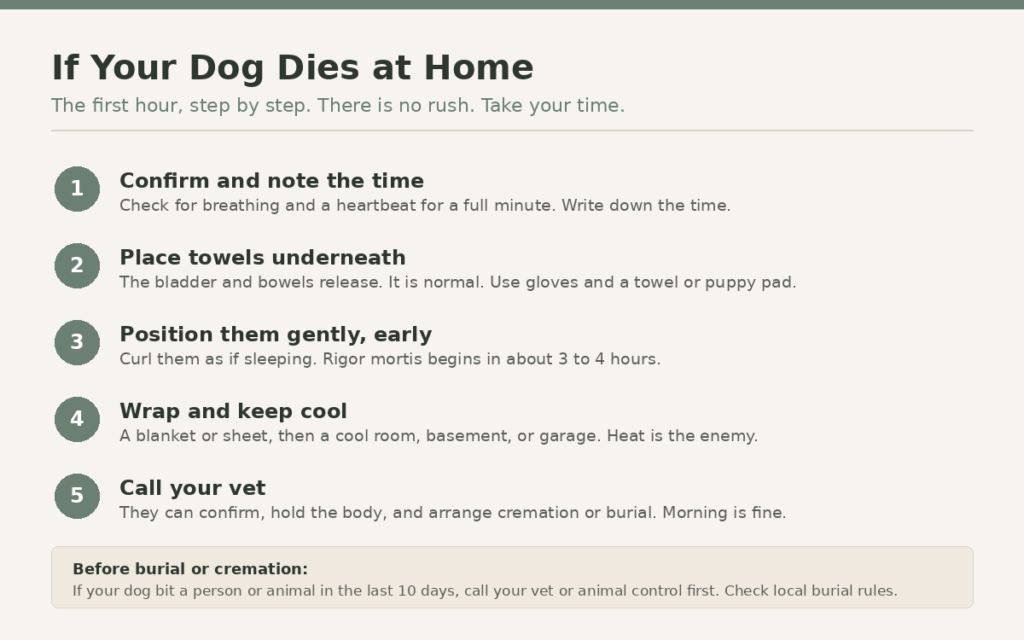
- Note the time of death. Your vet may ask, and it helps if you later want to understand what happened.
- Keep other pets and small children back at first. Give yourself a minute.
- Put on gloves if you have them. This is a hygiene step, nothing more.
- Place a towel, puppy pad, or plastic sheet under the body, especially under the back end.
- Gently position the body curled, as if sleeping, with the legs tucked.
- Wrap the body in a blanket, a towel, or a clean sheet. A heavy duty plastic bag or contractor bag over the blanket helps contain fluids.
- Move the body somewhere cool. A garage in winter, a basement, a tiled floor, or a cool room away from sun and heat.
- Call your vet. Even after hours. Most clinics have a voicemail or an emergency line, and this is one of the things they handle every week.
Do not use a freezer if you plan on a necropsy, since freezing damages tissue and can make findings unreliable.
How Long Can You Keep the Body at Home?
This is the question nobody wants to ask out loud, so here is a plain answer.
| Situation | Rough safe window |
|---|---|
| Room temperature, indoors | Only a few hours before decomposition begins |
| Cool room or basement, wrapped | Up to around 12 hours |
| Cold garage in winter, or on ice packs | Up to around 24 hours |
| Refrigerated at a vet or crematory | Several days, if needed |
Heat is the enemy. If it is summer and you cannot get to a vet today, ask if they will hold the body in their cooler until you decide. Most will, sometimes for a small fee, sometimes for nothing.
If you need a little time to let family say goodbye, place bags of ice or frozen gel packs around the body, wrapped in towels, especially near the belly.
Let Your Other Pets See, If They Want To
This one is not just sentiment. Many owners find their other dogs and cats search the house, whine, and pace for days when a companion simply disappears.
Letting them sniff the body for a minute or two often helps them settle. They do not need long. Some will show no interest at all, and that is fine too.
Watch the surviving pets for the next couple of weeks. Appetite loss, clinginess, and restlessness are common. Keep their walks and feeding times normal, since routine is the thing that steadies them.
Who to Call
| Who | When to call them |
|---|---|
| Your regular vet | First call. They can confirm, take the body, and arrange cremation |
| Emergency animal hospital | After hours, or if you are not sure the dog has died |
| Pet cremation service | Direct option. Many offer home pickup, some 24 hours a day |
| Pet loss aftercare company | Handles pickup, cremation, and return of ashes |
| Animal control | Only if the dog bit a person or animal recently, or if the death may be part of a disease concern |
| Your city or county | To check burial rules before you dig |
One important case. If your dog bit a person or another animal within the last 10 days, do not bury or cremate the body until you have called your vet or local animal control. Rabies testing rules may apply, and the head must be preserved for that. It is rare, but it matters.
Your Aftercare Options
Here are the real choices, with what each one involves.
1. Private Cremation
Your dog is cremated alone, and you get the ashes back, usually in a wooden box or urn.
- Ashes returned: yes, your dog’s only
- Typical turnaround: several days to two weeks
- Cost: often a few hundred dollars, scaled by weight
- Best for: owners who want the ashes
2. Communal Cremation
Several pets are cremated together. Ashes are not returned.
- Ashes returned: no
- Cost: usually the least expensive option
- Best for: owners who do not want ashes and want a simple, dignified option
3. Home Burial
Burying your dog in your own yard.
- Cost: free, aside from what you choose to mark it with
- Legal: allowed in many US areas, banned in others. Check before you dig
- Best for: owners with land, and no plan to move soon
4. Pet Cemetery
A dedicated plot with a marker.
- Cost: the most expensive option, with plot and marker fees
- Best for: owners who want a place to visit that stays put even if they move
| Option | Ashes returned | Rough cost | You can visit |
|---|---|---|---|
| Private cremation | Yes | Moderate | Wherever you keep the urn |
| Communal cremation | No | Lowest | No |
| Home burial | No | Free | Yes, while you live there |
| Pet cemetery | No | Highest | Yes, permanently |
Costs vary a lot by state and by the weight of the dog. Call two providers and compare. Prices for a 90 pound dog and a 10 pound dog are rarely the same.
Home Burial: Do This Right
If you choose burial, the rules exist for real reasons, mostly groundwater and wildlife.
Check first:
- Your city or county ordinance. Some ban pet burial outright, especially in dense urban areas.
- Your HOA rules.
- Whether you rent. Most leases do not allow it.
If it is allowed:
- Dig at least 3 feet deep, and deeper for a large dog. Shallow graves get dug up by wildlife.
- Stay at least 100 feet from wells, creeks, and any water source.
- Avoid burying in a plastic bag if you can. A biodegradable blanket, a cotton sheet, or a wooden box is better for the soil.
- Place a heavy stone or paver on top of the filled grave.
One serious warning. If your dog was euthanized, the euthanasia drug stays in the body. A scavenging animal that digs up the remains can be poisoned by it. Ask your vet before burying a euthanized pet, and take the depth rules seriously.
If You Do Not Know Why Your Dog Died
A sudden death with no warning is hard to accept. You may want answers.
A necropsy is an animal autopsy. Your vet or a university veterinary school can perform one.
Consider it if:
- Your dog was young and healthy
- You suspect poison, antifreeze, or a toxic plant
- You have other dogs in the house who could be at risk
- The death may matter for a breeder or a legal claim
If you want a necropsy, act fast. Refrigerate the body, do not freeze it, and call your vet the same day. Tissue changes quickly.
If you do not want one, that is a completely valid choice. Not everyone needs a reason, and not every reason brings comfort.
Taking Care of Yourself
You do not need permission to grieve a dog. This is a real loss.
Practical things that help in the first week:
- Keep the bed, bowl, and toys wherever they are for a few days if you are not ready. Or put them away immediately if that is easier. Both are normal.
- Tell your workplace if you need a day. More US employers than you would expect will grant it.
- Do not make a fast decision about getting a new dog. Wait until it feels like a want, not a fix.
- If the grief is not lifting, pet loss support lines and grief counselors exist for exactly this. Some veterinary schools run free ones.
Guilt is the heaviest part for most people. Did I miss a sign, should I have gone in sooner. If your dog died at home, unexpectedly and quietly, the honest answer is usually that there was nothing to see and nothing to catch.
FAQ
What do I do if my dog dies at home in the middle of the night? Wrap the body, place it somewhere cool, and wait until morning to call your vet. Nothing needs to happen at 3 a.m. If it is a hot night, put wrapped ice packs around the body. Some cremation services do offer 24 hour pickup if you would rather not wait.
Can I bury my dog in my backyard? Sometimes. It is legal in many parts of the US and banned in others, so check your city and county rules and your HOA first. If it is allowed, bury at least 3 feet deep and well away from any water source. If your dog was euthanized, ask your vet first, because the drug can harm animals that dig up the remains.
How long can I keep my dog’s body at home? A few hours at room temperature, and up to about a day if the body is wrapped and kept cold. After that, ask your vet or a crematory to hold the body in refrigeration while you decide.
Should I let my other dog see the body? Usually yes, if the other dog wants to. A minute or two of sniffing often helps them understand the companion is gone, and many owners see less searching and pacing afterward.
Do I have to tell anyone my dog died? There is no general requirement to report a pet death. Do call your vet, and update your microchip registry and your pet insurance so you stop getting reminders. And if your dog bit anyone in the last 10 days, call animal control before doing anything with the body.
Your Next Step
Right now, you only need to do three things. Wrap your dog gently. Move them somewhere cool. Call your vet in the morning, or a cremation service tonight if you would rather not wait.
Everything else, the burial or cremation choice, the ashes, the paw print, the box of toys, can wait until tomorrow. It will still be there, and you will think more clearly then.
You did not fail your dog. You are here, reading this, trying to do right by them at the very end. That is what a good owner does.