

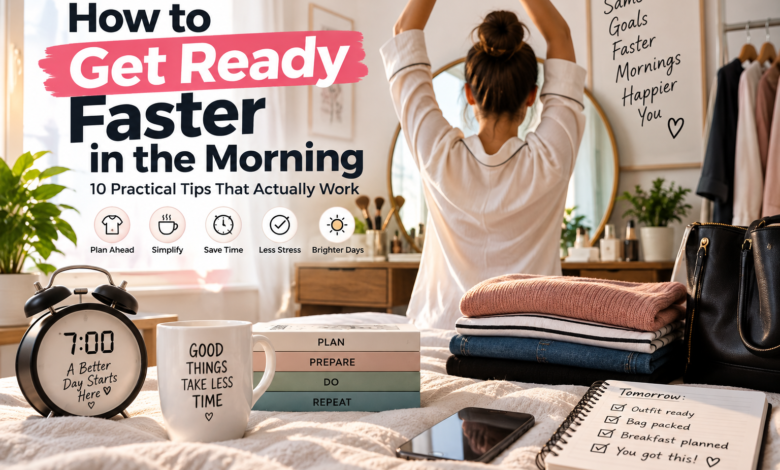
You wake up on time, check your phone for “just a minute,” start looking for something to wear, realise you forgot to pack your bag, and suddenly you are running late.
Sound familiar?
Getting ready faster in the morning is not necessarily about moving faster. In most cases, it is about having fewer things to decide, find, and organise after you wake up.
A good morning routine moves small tasks out of your busiest part of the day. Choosing clothes, packing a bag, deciding on breakfast, and finding your keys can often be handled beforehand.
If your mornings regularly feel rushed, these 10 practical tips can help you build a simpler routine and tell you how to get ready faster in the morning.
1. Prepare Your Clothes the Night Before
Choosing an outfit can take much longer than expected.
You pick a shirt. It does not work with the trousers. You change the trousers. Then you need different shoes. Something needs ironing.
Five or ten minutes disappear surprisingly quickly.
Instead, choose your complete outfit before going to bed.
That means preparing:
- Top
- Bottom
- Underwear
- Shoes
- Socks
- Accessories
- Jacket or outerwear, if needed
Check the weather and think about what you are doing the next day before making your choice.
Put everything together in one place.
In the morning, there is no decision to make. You simply get dressed.
Try the Outfit Formula Method
If choosing clothes is still taking too long, create a few reliable outfit formulas.
For example:
Work: trousers + plain top + blazer + comfortable shoes
Casual: jeans + T-shirt + sneakers
Workout: leggings or shorts + sports top + trainers
You do not need to wear exactly the same clothes every day. The formula simply removes some of the decision-making.
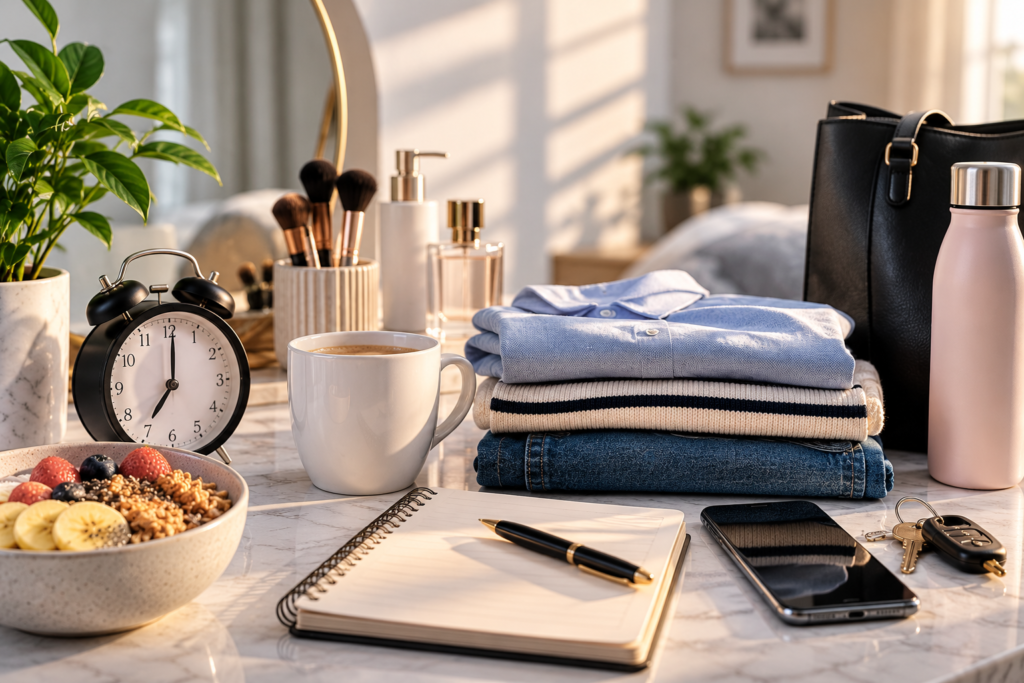
2. Pack Your Bag Before Bed
Do not wait until morning to start asking:
“Where’s my charger?”
“Did I pack my notebook?”
“Where are my headphones?”
Pack anything you can the night before.
For a work or school day, this might include your:
- Laptop
- Charger
- Notebook
- Wallet
- ID
- Headphones
- Documents
- Water bottle
- Gym clothes
Obviously, some things cannot be packed until morning. Your phone may still be charging, for example.
Keep those items together or make a short mental or written checklist.
The goal is to avoid searching the house for five different things when you should already be leaving.
3. Give Everyday Essentials a Permanent Home
Keys should have a home.
So should your wallet, glasses, work badge, earbuds, handbag, and other things you regularly take with you.
If you put these items in random places every evening, finding them becomes another morning task.
Create a small launch area near the door.
It might be a tray, drawer, shelf, basket, or set of hooks where your daily essentials always go.
When you return home:
Keys → tray
Bag → hook
Wallet → drawer
Work badge → bag
Once this becomes a habit, “Where are my keys?” should become a much less frequent part of your morning.
4. Decide on Breakfast Before Morning
Breakfast can become surprisingly time-consuming when you have no idea what you want.
You open the refrigerator.
Close it.
Open a cupboard.
Check the refrigerator again.
Then start preparing something that takes longer than expected.
Instead, have a small list of quick breakfasts you already know you like.
| Morning Situation | Simple Option |
|---|---|
| Very rushed | Banana + yogurt |
| Normal weekday | Oatmeal + fruit |
| Need something portable | Overnight oats |
| Want more preparation ahead | Pre-made breakfast wrap |
| Prefer something simple | Toast + eggs |
You do not need a complicated weekly meal plan.
Even knowing tonight what you will eat tomorrow morning removes another decision.
If appropriate, prepare part of it in advance.
5. Stop Checking Your Phone While Getting Ready
This may be one of the simplest ways to make a morning routine faster.
You pick up your phone to check the weather.
Then you notice a message.
Then a notification.
Then you open social media.
Ten minutes later, you are still holding your phone.
If this happens regularly, create one simple rule:
No unnecessary phone use until I am ready.
Use your phone for things you genuinely need, such as checking an urgent message, transport information, or the weather.
Leave social media, videos, news browsing, and casual messages until later.
You may be surprised by how much shorter your routine feels when it is not repeatedly interrupted.
6. Simplify Your Grooming Routine
A weekday morning does not always need your longest possible beauty or grooming routine.
Think about the steps you actually need before leaving home.
Your routine might be:
Shower → skincare → hair → makeup/grooming → dress
Then look for steps that repeatedly slow you down.
Could some hair preparation happen the night before?
Can everyday grooming products stay together?
Do you regularly waste time looking for a specific brush, moisturiser, razor, or cosmetic?
Keeping frequently used products organised and accessible can make the process much smoother.
A small basket or dedicated section of your bathroom can work well for daily products.
The point is not to rush personal care. It is to remove unnecessary searching and switching between tasks.
7. Work Backwards From the Time You Need to Leave
A vague plan such as “I need to leave early tomorrow” is easy to ignore.
Use an actual departure time instead.
Suppose you must leave at 8:00 AM.
Work backwards:
| Task | Time |
|---|---|
| Leave home | 8:00 |
| Shoes, coat, final check | 7:55 |
| Breakfast | 7:40 |
| Hair/grooming | 7:20 |
| Get dressed | 7:10 |
| Shower | 6:55 |
| Wake up | 6:50 |
Your exact routine will obviously be different.
The important part is knowing when each stage should roughly happen.
It also helps you identify the real problem.
If your routine requires 60 minutes but you normally wake up only 35 minutes before leaving, organisation alone cannot solve the entire problem.
8. Create a Five-Minute Leaving Buffer
If you need to leave at 8:00, do not plan to finish getting ready at exactly 8:00.
Try to be ready by 7:55.
Those extra five minutes can absorb small delays such as:
- Finding something you forgot
- Filling your water bottle
- Using the bathroom
- Putting on a jacket
- Checking that windows or doors are secure
- Waiting for the lift
- Dealing with an unexpected message
Without a buffer, one tiny delay can make you late.
With one, a small problem stays small.
9. Keep Your Morning Routine in the Same Order
You should not have to invent your morning every day.
Create a basic sequence and repeat it.
For example:
Wake up → bathroom → shower → skincare → get dressed → breakfast → teeth → grab bag → leave
Your exact order does not matter as much as consistency.
When you follow roughly the same sequence, it becomes easier to notice what is slowing you down.
Maybe breakfast takes longer than you thought.
Maybe hair is the problem.
Maybe you are actually ready quickly but spend 15 minutes looking for things before leaving.
Once you know the bottleneck, you can fix it.
10. Fix Your Night Routine, Not Just Your Morning Routine
Sometimes the best answer to how to get ready faster in the morning begins the night before.
If you stay up too late, wake up exhausted, snooze repeatedly, and struggle to get moving, an extremely organised bathroom counter will only help so much.
Most adults need at least seven hours of sleep, although individual needs vary. The CDC recommends seven or more hours for adults aged 18–60.
A regular sleep and wake schedule can also support healthier sleep patterns. The National Heart, Lung, and Blood Institute recommends consistent bed and wake times and reducing bright artificial light before bed.
Try creating a simple evening sequence:
Prepare clothes → Pack bag → Prepare breakfast → Put essentials by door → Set alarm → Wind down → Sleep
You are essentially doing tomorrow morning a favour.
The easier you make the next morning before you go to sleep, the less work remains when the alarm goes off.
A Simple 30-Minute Morning Routine
If you want a basic routine to test, try this:
| Time | Task |
|---|---|
| 0–5 minutes | Wake up and bathroom |
| 5–15 minutes | Shower and basic grooming |
| 15–20 minutes | Get dressed |
| 20–25 minutes | Quick breakfast |
| 25–30 minutes | Teeth, shoes, bag and leave |
This will not suit everyone.
Someone with longer hair, a detailed makeup routine, children, pets, medication, a longer breakfast, or other responsibilities may need considerably more time.
Do not treat 30 minutes as a rule.
Instead, time your current routine for a few days and create a realistic schedule based on your actual morning.
Frequently Asked Questions
How can I get ready faster in the morning?
Prepare as much as possible the night before. Choose your clothes, pack your bag, decide on breakfast, and put your keys and essentials in one place. In the morning, follow a consistent routine and avoid unnecessary phone use.
What should I prepare the night before?
Start with your outfit, bag, work or school essentials, breakfast plan, keys, wallet, and anything else you regularly search for in the morning.
How can I stop wasting time before work?
Identify where your time is actually going. For a few mornings, note how long you spend on showering, dressing, breakfast, grooming, your phone, and finding belongings. Fix the biggest time-waster first.
Is it better to shower at night or in the morning?
It depends on your routine and personal preference. If showering in the morning regularly makes you late, moving it to the evening may save time. If a morning shower helps you feel ready for the day, keep it and simplify another part of your routine.
How do I stop hitting snooze?
A consistent sleep schedule and enough sleep may make mornings easier. The NHLBI recommends maintaining regular sleep and wake times and allowing enough time for sleep. You can also place your alarm somewhere that requires you to get out of bed, but avoid sacrificing necessary sleep simply to wake earlier.
How long should it take to get ready in the morning?
There is no ideal number. Your routine depends on your grooming needs, breakfast, commute, family responsibilities, and what you need to do before leaving. Instead of aiming for an arbitrary time, make your existing routine more predictable and efficient.
Final Thoughts
Learning how to get ready faster in the morning is less about rushing and more about preparation.
Start with the easiest changes.
Choose tomorrow’s clothes tonight. Pack your bag. Put your keys in the same place. Decide on breakfast. Stay off distracting apps while getting ready. Follow the same basic routine each day.
You do not need a perfect 5 AM routine or a complicated productivity system.
You simply need fewer decisions and fewer things to search for when you are already short on time.
Prepare more tonight, and tomorrow morning becomes much easier.