

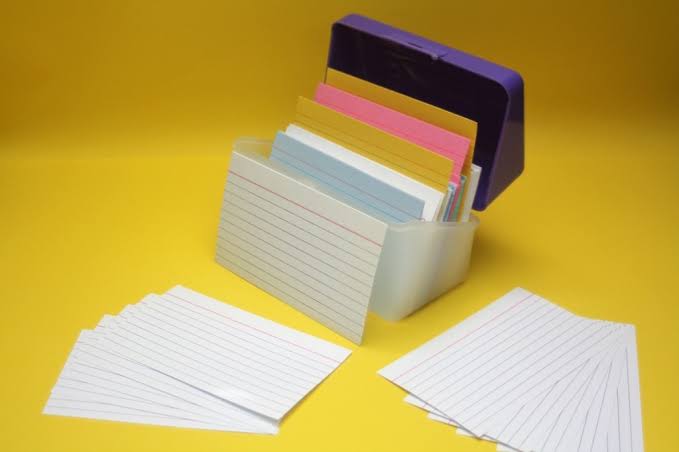
Index cards are one of the most powerful study tools there is, when you use them the right way. To study with index cards, put a question on the front and the answer on the back, then quiz yourself by trying to recall the answer before flipping the card. That act of pulling the answer from memory, rather than just re-reading it, is what makes them work. Space your reviews out over days, and you remember far more. Here is exactly how to use index cards to study and actually retain what you learn.
I have used index cards through years of studying, and the science backs up why they work so well. The trick is not writing them, it is how you test yourself with them. Let us get into the method.
How to Use Index Cards to Study (Quick Answer)
The method in five steps:
- Write one question on the front, the answer on the back.
- Keep each card to a single idea.
- Quiz yourself by recalling the answer before you flip.
- Sort cards into ones you knew and ones you missed.
- Review the missed ones more often, and space out your reviews.
The magic is in the self-testing, not the writing. That is the part most people skip.
Why Index Cards Work So Well
Index cards work because they force active recall, which means pulling information out of your memory instead of just looking at it. And active recall is one of the most proven study methods there is.
Research by Karpicke and Blunt, published in the journal Science, found that actively recalling information produced far more learning than simply re-reading it. A landmark review of study techniques by Dunlosky and colleagues rated practice testing, exactly what index cards do, as one of the most effective strategies of all.
So when you quiz yourself with a card and struggle to remember, that struggle is the learning happening. Re-reading feels easier but works far worse.
How to Make Good Index Cards
Good cards make studying easier. A few rules keep them effective.
- One idea per card. Do not cram. Each card should test a single fact or concept.
- Ask a question. Phrase the front as a question, so the card prompts recall.
- Keep answers short. A clear, brief answer is easier to review.
- Use your own words. Writing it yourself helps you understand it.
- Add a cue if helpful. A small hint or image can aid memory.
Well-made cards turn studying into quick, focused self-tests. Cluttered cards slow you down and blur the point.
How to Actually Study With Them
Making the cards is only half the job. How you review them is what locks in the learning.
- Look at the question and try hard to recall the answer before flipping
- Say or write the answer, do not just think you know it
- Be honest: if you did not know it, put it in the review-again pile
- Go through the pile, sorting into known and unknown
- Come back to the unknown cards more often
This sorting method, focusing on what you do not know, is far more efficient than reviewing every card equally.
Carry Them Everywhere
One underrated benefit of index cards is that they turn dead time into study time. A small stack fits in a pocket or bag and goes anywhere.
Pull them out while waiting for the bus, standing in a line, or on a break. A few minutes of self-testing here and there adds up to a lot of review over a week, without setting aside big blocks of time. This is one reason index cards beat bulky notes: you can actually study them in the small gaps of your day.
Space Out Your Reviews
Here is the second big secret, alongside self-testing: do not cram all your reviews into one session. Spread them out over days.
Reviewing a card today, then in two days, then in a week, helps the information stick far better than going through it ten times in one night. This spacing gives your memory time to strengthen. Cramming the night before feels productive but fades fast, while spaced reviews build lasting memory.
Digital or Paper: Which Is Better?
You might wonder whether paper index cards or a flashcard app is better. The honest answer: both work, because both use the same powerful principle of active recall.
Paper cards have real advantages. Writing them by hand helps you learn the material as you make them, and there are no screen distractions. Apps, on the other hand, can automatically space your reviews for you and are easy to carry everywhere. Pick whichever you will actually use. The method matters far more than the format. If you love the feel of writing and sorting real cards, paper is great. If you want reviews scheduled automatically, an app works well.
Common Mistakes to Avoid
Avoid these and your index cards will work much better.
| Mistake | Do this instead |
|---|---|
| Cramming too much on one card | One idea per card |
| Just re-reading the cards | Recall the answer before flipping |
| Reviewing every card equally | Focus on the ones you miss |
| Studying all in one session | Space reviews over days |
| Copying word for word | Use your own words |
Index Cards Work for Almost Any Subject
One reason index cards are so useful is how flexible they are. They fit almost any subject you need to learn.
Use them for vocabulary and language learning, with the word on one side and the meaning on the other. Use them for definitions, dates, and facts in history or science. Use them for formulas in math, with the problem type on the front and the method on the back. Even for big concepts, you can put a prompt on the front and force yourself to explain the idea aloud. Wherever you need to remember something, a question-and-answer card can help you learn it faster.
Frequently Asked Questions
How do you study with index cards effectively? Put a question on the front and the answer on the back, then quiz yourself by recalling the answer before flipping. Sort cards into known and unknown, review the unknown more often, and space your reviews over days.
Why are index cards good for studying? They force active recall, which research shows is far more effective than re-reading. Studies by Karpicke and Blunt and reviews by Dunlosky rate self-testing among the most powerful study methods.
How many index cards should I study at once? Work in small batches you can focus on, then sort into known and unknown. Spend more time on the unknown pile. Small, focused sessions spread over days beat one long cram.
Are index cards better than just re-reading notes? Yes. Re-reading feels easier but is far less effective. Index cards make you retrieve the answer from memory, which is the effort that actually builds lasting learning.
Make Your First Deck Today
The best way to learn this method is to try it. Grab a stack of index cards, pick one topic you are studying, and make ten cards with a question on each front and the answer on the back. Then quiz yourself, recalling before you flip. You will feel the difference from passive reading right away. Start your first deck today, and space your reviews from there. Stick with the method for a week and you will notice how much more you remember with far less time spent.